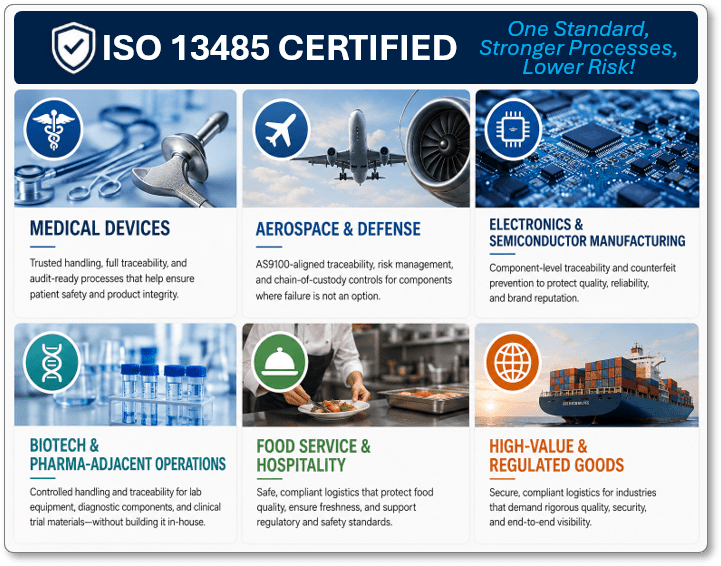
ISO 13485 was written for one purpose: to give medical device manufacturers a quality management system rigorous enough to protect patient safety. But a growing number of companies with no interest in making medical devices are seeking out ISO 13485-certified logistics partners anyway — not for the certification itself, but for what earning it proves about how a partner actually operates.
As ISO 13485’s own documentation notes, an organization does not need to be actively manufacturing medical devices or their components to pursue the standard. That flexibility is exactly why it’s starting to show up in industries that have nothing to do with healthcare.
Why companies outside medical devices are paying attention
The pull isn’t regulatory — it’s operational. ISO 13485 forces a level of discipline most general logistics providers never build: full lot- and serial-level traceability, documented supplier qualification, formal deviation and corrective-action processes, and controlled storage and handling verified by independent audit. For any company moving high-value, sensitive, or liability-exposed goods, those same controls solve real problems, whether or not a "device" is involved.
Where we’re seeing this show up
Electronics and semiconductor manufacturing
Component-level traceability — tracking a part back to its lot, supplier, and inspection record — is now standard practice in electronics manufacturing, largely to catch counterfeit components and isolate defects quickly; it’s explicitly required in both aerospace (AS9100) and medical device (ISO 13485) manufacturing according to PCB traceability specialists Anzer USA. NXP’s own engineering blog goes further, arguing that ISO 13485-certified supplier oversight delivers "operational advantages… across diverse industrial sectors, extending well beyond traditional healthcare applications" (NXP) — because the same supplier qualification and component traceability rigor that protects a patient also protects a circuit board headed into a mission-critical system.
Aerospace and defense
Aerospace and defense already run on their own strict traceability standard, AS9100, precisely because a part failure carries consequences on a similar order to a medical device failure. While AS9100 remains the formal requirement in that industry, the underlying expectation — full chain-of-custody on every component, documented risk management, audit-ready records — mirrors the discipline ISO 13485 enforces. Major global logistics providers have picked up on this overlap directly: SEKO Logistics built out an ISO 13485-certified logistics hub specifically to serve customers not just in medical, but in "aerospace, automotive, energy, government, industrial, retail, technology, and trades" (SEKO Logistics).
Biotech and pharma-adjacent operations
Biotech companies handling lab equipment, diagnostic components, or clinical trial materials often sit right at the edge of formal medical device regulation without being classified as one. For these companies, an ISO 13485-certified logistics partner offers the same rigorously controlled handling and traceability their clinical and diagnostic partners already expect, without needing to build that infrastructure in-house.
High-value and regulated goods generally
Global logistics provider Geodis makes the pattern explicit in its own commentary: "for many industries, certification isn’t optional. Healthcare, food, automotive, and aerospace companies often require ISO certifications… before they’ll even consider" a provider (Geodis). As supply chains globalize and liability exposure grows, more industries are converging on the same short list of quality benchmarks — and ISO 13485 sits at the top of that list for rigor.
What “enterprise-grade operational discipline” actually looks like
- Full lot- and serial-level traceability from receiving through shipment
- Documented, audited supplier qualification and ongoing performance monitoring
- Formal corrective and preventive action (CAPA) processes for any deviation
- Controlled storage conditions with verified environmental and access controls
- Audit-ready documentation available on demand, not reconstructed after the fact
How Mendtronix fits in
Mendtronix built its ISO 13485 certified, FDA-registered operations for medical device brands — but the same traceability, controlled handling, and audit-ready documentation are available to any company that needs that level of operational discipline, regardless of industry. If your supply chain carries the kind of risk exposure that generic fulfillment wasn’t built to handle, reach out to our team to talk through what that would look like for your operation.